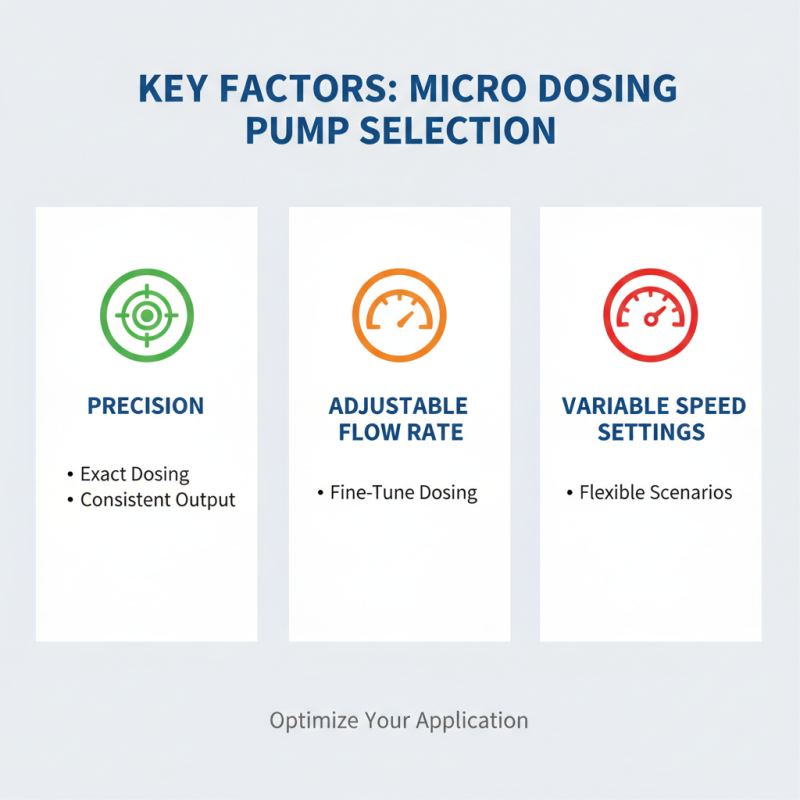
2026 How to Choose the Right Micro Dosing Pump for Your Needs?
As industries increasingly turn to precision in fluid management, choosing the right Micro Dosing Pump becomes crucial. A recent report from the Global Dosing Pump Market states that the market is projected to grow at a CAGR of 5.3% by 2026. This growth highlights the importance of selecting a pump that meets specific needs for accuracy and efficiency.
Dr. Lisa Montgomery, an expert in fluid dynamics, emphasizes, "The right Micro Dosing Pump can significantly impact operational efficiency." With various types and features available, it can be challenging to navigate through the options. Factors like flow rate, chemical compatibility, and application type often leave users overwhelmed.
Mismatches between pump capabilities and user requirements can lead to inefficiencies. Users must consider their project specifics. This often requires deep reflects and an understanding of both technology and application. Choosing wisely ensures not just performance, but also cost-effectiveness in the long run. A thoughtful decision is key to leveraging the full benefits of a Micro Dosing Pump.

Understanding Micro Dosing Pumps and Their Applications
Micro dosing pumps are crucial tools in various industries. They allow precise measurement and delivery of liquids. These pumps find applications in chemistry, pharmaceuticals, and food production. Each industry has unique requirements. Understanding these needs will help in making an informed choice.
In chemical processes, for example, accuracy is key. A micro dosing pump may need to handle aggressive liquids. Meanwhile, in pharmaceuticals, sterile operations are essential. The right pump must ensure contamination-free delivery. Consider environmental factors too. Temperature and pressure variations can affect pump performance.
Take time to assess these conditions.
Selecting a pump is not solely a technical decision. It involves understanding your operation's nuances. Reflection on past experiences can offer insights. The complexity of your fluid may require trial and error. Choosing the wrong pump can lead to costly disruptions. Achieving optimal performance takes effort and patience.
Comparing Different Types of Micro Dosing Pumps
When selecting a micro dosing pump, understanding the different types available is crucial.
Reciprocating pumps are widely used for their accuracy and reliability.
They function by drawing liquid into a chamber and then dispensing it in precise amounts. Their design allows for meticulous control, making them suitable for laboratories and precision applications.
Peristaltic pumps offer another option, known for their gentle handling of liquids. They work by squeezing a tube, which minimizes shear stress.
This feature is ideal for sensitive substances, such as cell cultures.
However, they often require tube replacements, which can lead to inconsistencies over time. Users should weigh the maintenance needed against their operational frequency.
Diaphragm pumps are versatile and can handle a variety of fluids. They are less prone to leaks when maintained properly.
Yet, users might encounter issues with pressure fluctuations, affecting performance. Each type of pump has its pros and cons.
Finding the right fit involves evaluating specific application needs critically.
Assessing the Specific Needs of Your Application
When selecting a micro dosing pump, it is crucial to assess the specific needs of your application. Different industries require precise fluid delivery, which leads to varying specifications for pumps. According to a market analysis by Grand View Research, the micro dosing pump market is projected to reach $3 billion by 2026. This growth highlights the necessity for tailored solutions.
Consider the viscosity of the fluid being dosed. It significantly impacts pump selection. For example, thicker fluids may require pumps with higher torque capabilities. Likewise, the required flow rate defines the pump size and design. Reports suggest that around 30% of system failures stem from inappropriate pump selection based on these parameters.
Moreover, understanding the environment of use is essential. Micro dosing pumps must resist corrosive substances and withstand varying temperatures. Inadequate consideration of these factors can lead to frequent maintenance. It is estimated that 25% of maintenance issues arise due to environmental mismatches. Thus, a thorough evaluation of application needs ensures reliability and longevity in pump performance.
Maintenance and Support for Your Micro Dosing Pump
Selecting the right micro dosing pump is crucial for optimal performance. However, maintenance and support play an equally important role in ensuring longevity and efficiency. Data from industry reports indicate that over 30% of micro dosing pump failures stem from inadequate maintenance practices. Regular upkeep can significantly reduce these risks.
Proper maintenance involves routine inspections and performance evaluations. Regular calibration ensures accurate dosing. A well-maintained micro dosing pump can achieve a typical uptime of 95%, according to industry standards. Meanwhile, a lack of proper support can lead to frustration. Access to expert advice and troubleshooting resources is vital for operators.
Another important consideration is the training of personnel. Ongoing training can help operators understand operational limits and identify early signs of wear. Reports show that properly trained users can reduce downtime by up to 40%. A reactive approach to maintenance often leads to unexpected failures. Emphasizing a proactive maintenance strategy can create a more reliable system.
2026 How to Choose the Right Micro Dosing Pump for Your Needs? - Maintenance and Support for Your Micro Dosing Pump
| Feature |
Description |
Considerations |
| Flow Rate |
The volume of fluid a pump can deliver over time. |
Choose based on your application's requirements (ml/min). A pump's flow rate should match your dosing frequency. |
| Accuracy |
The degree to which the pump can deliver the desired amount of fluid. |
Look for pumps with high precision for critical applications. |
| Power Source |
The mechanism that powers the pump (electric, pneumatic, manual). |
Consider your operational environment and power availability. |
| Material Compatibility |
The chemical resistance of pump materials to the liquids being pumped. |
Ensure materials can withstand the fluids used in your processes. |
| Control Options |
Methods for adjusting the pump's operation (manual, remote, automated). |
Select controls that fit your workflow and automation needs. |
| Maintenance Requirements |
Routine checks and part replacements necessary for operation. |
Choose pumps with easier maintenance for long-term reliability. |
| Cost |
The total price of the pump and any associated costs. |
Consider upfront and ongoing operational costs, including maintenance. |