
Leave Your Message
What Is a Lamella Clarifier and How Does It Work?
A lamella clarifier is a compact sedimentation unit used to remove suspended solids from industrial and municipal water. It uses inclined plates, called lamellae, to increase settling area without requiring a large footprint. As water flows upward between these plates, heavier particles slide downward into a sludge hopper. Clarified water leaves through collection channels near the surface.
The principle looks simple. Plant performance is not always simple. Flow distribution, floc strength, plate spacing, surface loading, and sludge removal can change results significantly. The U.S. Environmental Protection Agency identifies hydraulic loading and solids separation as key considerations in clarification design. The European Commission’s Best Available Techniques Reference Document for Common Waste Water and Waste Gas Treatment also emphasizes reliable pretreatment, process control, and regular maintenance.
This technology matters as water demand and treatment pressure increase. The United Nations World Water Development Report has warned that most global wastewater receives inadequate treatment. Every lost particle can increase downstream filtration, disinfection, or disposal demands. A well-designed lamella system can reduce suspended solids while using less land than conventional settling tanks.
The term “Lamella Charifier” is sometimes used in searches, although “Lamella Clarifier” is the correct engineering term. That distinction matters when reviewing specifications, performance guarantees, and supplier documentation. Operators should not judge the unit by appearance alone. A clean outlet channel may hide poor sludge withdrawal below. Careful testing is essential, especially when wastewater composition changes by season, production batch, or storm event.
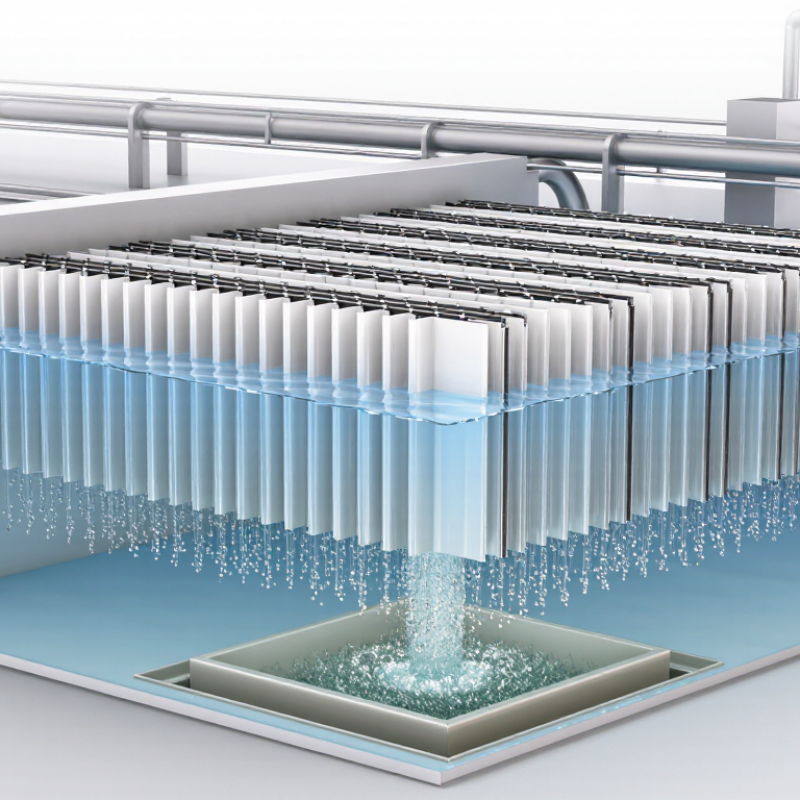
A lamella clarifier is a compact sedimentation unit designed to remove suspended solids from wastewater. It contains many closely spaced, inclined plates or tubes. These surfaces create extra settling area inside a smaller tank. The main purpose is clear and practical: reduce turbidity before filtration, biological treatment, or discharge. It can also recover solids from process water and sludge streams.
During operation, wastewater flows upward between the inclined plates. Heavier particles lose momentum and settle onto the plate surfaces. Gravity then moves the collected solids downward into a sludge hopper. Clarified water leaves through an outlet near the top. The short settling distance improves separation compared with a conventional open tank. Flow control remains important. Excessive velocity can carry solids upward.
In field applications, operators check sludge depth, inlet distribution, and plate fouling. Uneven flow may create cloudy outlet water, even when the unit is correctly sized. A common mistake is treating the clarifier as a complete treatment system. It mainly separates settleable material; dissolved pollutants usually remain in the water. Plate spacing, particle density, temperature, and surface loading all affect performance. Cold water can settle more slowly. Regular inspection helps reveal scaling, biological growth, or blocked sludge discharge. Some designs work well, but no clarifier performs equally under every wastewater condition.
| Data Dimension | Key Information | Technical Description |
|---|---|---|
| Definition | Inclined-plate sedimentation unit | A lamella clarifier is a compact settling device that uses a series of closely spaced, inclined plates or tubes to separate suspended solids from liquid by gravity. |
| Primary Purpose | Solid–liquid separation | Its main purpose is to remove settleable and flocculated suspended solids from water or wastewater before downstream treatment, filtration, reuse, or discharge. |
| Operating Principle | Gravity settling on inclined surfaces | As water flows between the inclined plates, solids move downward along the plate surfaces while clarified liquid moves upward toward the outlet zone. |
| Main Separation Mechanism | Floc settling | Particles collide and form larger flocs through coagulation and flocculation, making them heavy enough to settle onto the inclined plates. |
| Typical Plate Inclination | Approximately 45–60 degrees | Inclined plates are commonly installed within this range to support downward movement of settled solids and reduce the risk of solids accumulation. |
| Flow Direction | Usually counter-current | In many designs, water flows upward between the plates while settled solids slide downward, improving separation within a relatively small footprint. |
| Key Components | Feed zone, plate pack, sludge hopper, and outlet | The feed zone distributes the incoming flow, the plate pack provides settling surfaces, the hopper collects sludge, and the outlet gathers clarified water. |
| Pre-Treatment Requirements | Screening and, when required, coagulation/flocculation | Coarse debris should be removed before the unit. Chemical conditioning may be used when fine or colloidal particles do not settle effectively on their own. |
| Hydraulic Loading Concept | Projected surface-area loading | Lamella clarifiers increase effective settling area by using the horizontal projection of multiple inclined plates rather than relying only on the tank footprint. |
| Space Requirement | Generally smaller than conventional settling tanks | The stacked plate arrangement provides a large effective settling area in a compact tank, which is useful where available land or floor space is limited. |
| Common Applications | Water and wastewater clarification | Typical applications include drinking-water treatment, industrial process-water treatment, municipal wastewater treatment, stormwater treatment, and tertiary clarification. |
| Typical Feed Solids | Settleable solids and chemically formed flocs | The unit is most effective when the incoming particles have adequate density and settling characteristics. Very light, buoyant, or poorly flocculated solids may require additional treatment. |
| Sludge Collection | Gravity discharge or mechanical removal | Settled solids slide from the plate surfaces into a lower hopper, where they can be removed continuously or intermittently depending on the design and sludge production rate. |
| Clarified-Water Collection | Outlet launders or collection channels | After passing through the plate section, clarified water is collected through evenly distributed outlets to help maintain balanced hydraulic loading. |
| Advantages | Compact footprint and high effective settling area | Benefits commonly include reduced space requirements, modular construction, relatively short hydraulic paths, and efficient removal of appropriately flocculated suspended solids. |
| Limitations | Sensitivity to flow distribution and solids characteristics | Poor inlet distribution, excessive hydraulic loading, inadequate flocculation, plate fouling, or high sludge accumulation can reduce clarification performance. |
| Important Design Factors | Flow rate, particle settling velocity, temperature, and solids concentration | Design should consider peak and average flows, water temperature, influent quality, floc strength, sludge production, plate spacing, access for cleaning, and the required effluent quality. |
| Routine Maintenance | Inspection, cleaning, and sludge removal | Regular maintenance may include checking inlet and outlet distribution, removing accumulated solids, cleaning plate surfaces when needed, and inspecting sludge withdrawal equipment. |
| Performance Monitoring | Turbidity, suspended solids, flow, and sludge level | These parameters help operators identify hydraulic imbalance, insufficient coagulation or flocculation, plate fouling, excessive sludge storage, or other operating problems. |
| Best-Suited Conditions | Stable flow with particles that settle or can be flocculated | Lamella clarification is particularly suitable when the feed contains suspended matter that can form dense, settleable flocs and when a compact clarification stage is required. |
Note: Actual capacity, removal efficiency, plate spacing, and operating conditions must be established through site-specific water-quality testing and engineering design.